Teaching a Miele Washing Machine to Wait for Cheap Electricity
Our washing machine died, so I bought a Miele for its native Home Assistant integration, then found it has no delayed-start register like the dishwasher.
Our washing machine died on a Sunday, which is exactly when appliances die. I didn’t shop around much. I picked a Miele partly because ours was actually broken and partly because Miele has had a core Home Assistant integration since HA 2025.5 — no HACS, no third-party maintainer who might disappear. After the dishwasher, I assumed I knew what I was getting into.
I didn’t, quite.
What the integration actually gives you
Add the miele integration and the washer shows up with a wide set of entities:
sensor.washing_machine                    — enum: idle, in_use, program_ended, ...
sensor.washing_machine_program             — cottons, woollens, quick_intense, ...
sensor.washing_machine_program_phase       — main_wash, rinse, spin, ...
sensor.washing_machine_remaining_time
sensor.washing_machine_elapsed_time
sensor.washing_machine_energy_consumption / _forecast
sensor.washing_machine_water_consumption / _forecast
sensor.washing_machine_twindos_1_level / _2_level
binary_sensor.washing_machine_door
binary_sensor.washing_machine_remote_control
binary_sensor.washing_machine_problem
button.washing_machine_start / _stop / _pause
That main status sensor has nineteen possible values, which surprised me until I realised it’s shared across Miele’s whole appliance line. supercooling and superfreezing are in there for fridges and freezers. A washing machine will never see them, but the integration doesn’t know that in advance, so you get the full enum either way.
The button that wasn’t there
I wanted the same trick as the dishwasher: load a program, tap one button, and let it start whenever electricity is cheapest. On the Bosch side that’s a single select.dishwasher_finish_at entity — set a time, the machine counts backwards itself.
Miele has no equivalent. No delay select, no relative-start number. Just three buttons: start, stop, pause. If you want a delayed start, you provide the delay.
So instead of setting a device register, the automation stores an absolute timestamp and waits for it:
# script: pick the cheapest hour, write it to a helper
best_hour: >
  {% set ns = namespace(best_price=999, best_hour='') %}
  {% for p in prices %}
    {% if as_timestamp(p.hour) > as_timestamp(now()) + 1800
       and p.price < ns.best_price %}
      {% set ns.best_price = p.price %}
      {% set ns.best_hour = p.hour %}
    {% endif %}
  {% endfor %}
  {{ ns.best_hour }}
# then: input_datetime.set_datetime with that value

# automation: fires once, at whatever the helper says
triggers:
  - trigger: time
    at: input_datetime.vaskemaskine_planlagt_start
conditions:
  - condition: state
    entity_id: sensor.washing_machine
    state: ["programmed", "waiting_to_start", "reserved"]
actions:
  - action: button.press
    target:
      entity_id: button.washing_machine_start
A time trigger pointed at an input_datetime re-reads the helper on every reload, so a restart between now and the scheduled hour doesn’t lose the plan — a plain delay: step inside a script would.
Buttons that don’t exist until you ask nicely
Here’s the part that actually stopped me for twenty minutes: button.washing_machine_start wasn’t in the state machine at all. Not unavailable — genuinely absent, 404 on lookup. It turned out Miele ships all three control buttons disabled by default in the entity registry. Someone at Miele decided that letting an automation remotely start a washing machine, unattended, deserves an opt-in, and I think that’s a reasonable position for a machine that fills itself with water. I enabled all three and reloaded the config entry, and they appeared — showing unavailable until a program is actually loaded, same as the dishwasher’s buttons do when idle.
Two machines, one speaker
Both appliances announce themselves on the kitchen speaker when they finish. I copied the dishwasher’s automation almost verbatim for the washer and only noticed the problem after it had already spoken once: it said “the wash is done,” which is fine until the dishwasher finishes twenty minutes later and says exactly the same sentence. Now one says “the washing machine is done” and the other “the dishwasher is done.” Small fix, but it’s the kind of thing that only shows up once you actually have two machines announcing things on the same speaker.
Where this still falls short
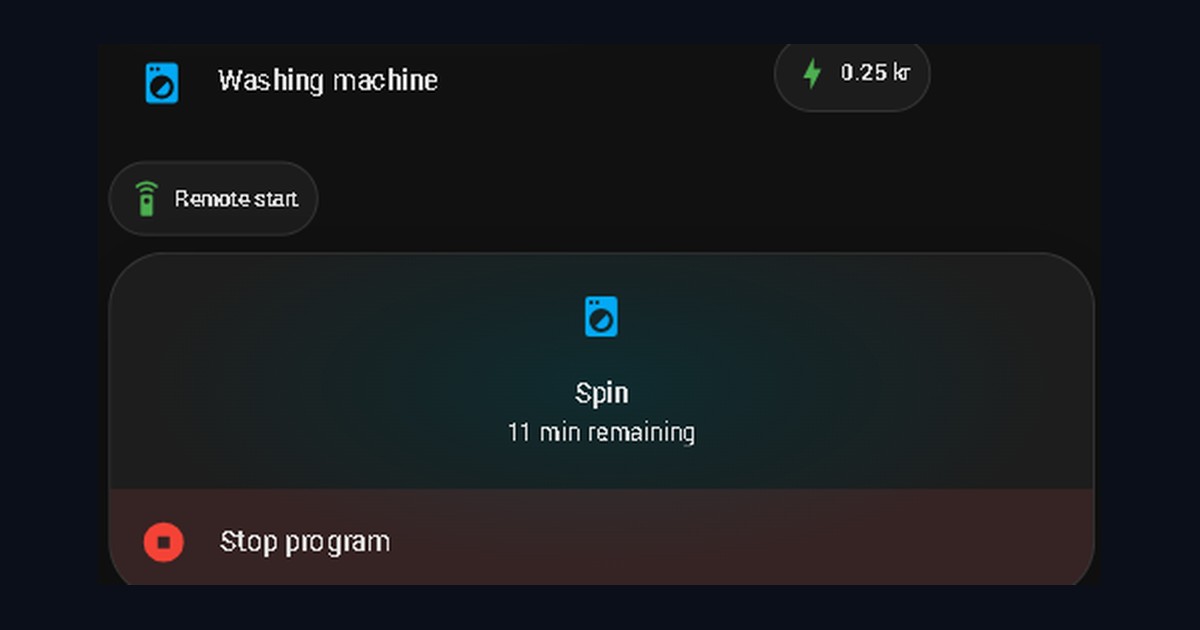
There’s no percentage-complete sensor. The dishwasher (Bosch/Home Connect) exposes a clean 0–100 progress value; Miele only gives elapsed and remaining minutes. I could compute a percentage myself, but a derived number that isn’t actually reported by the machine felt like the wrong thing to put on a dashboard, so the card just shows the phase and the minutes left.
The binary_sensor.washing_machine_problem sensor is also frustratingly vague — it flips to on, and that’s it. No error code, no description. I have a ticker entry for it, and it says “check it,” which is honest but not exactly actionable.
I copied the cheapest-hour price lookup from the dishwasher’s script almost exactly, including a bug I hadn’t noticed until this week: the sensor’s hour field is a real Python datetime, but once it passes through a script’s variables: field it becomes a plain string, so a later selectattr(..., 'eq', best_hour) against fresh sensor data never matches anything and the notification silently fails. Both scripts store the price separately now instead of re-searching for it.
The newest one is worse than the others. The washing machine powers itself off after about fifteen minutes if it’s just sitting there with a program loaded but not started — I found out when a “start at tomorrow’s cheapest hour” plan simply vanished from the dashboard the next day, no error, nothing. I went looking for a setting for it in the Miele app. Doesn’t exist, as far as I can tell — probably an EU standby-power requirement, not something Miele made configurable. Which means the whole “schedule the cheapest hour a day out” trick dies quietly if that hour is more than about fifteen minutes away. I patched it with an automation that reminds me fifteen minutes beforehand, so I can reload the program before the machine gives up. A workaround, not a fix. If you know a way around this one, I’d genuinely like to hear it.
New posts in your feed reader: follow with RSS